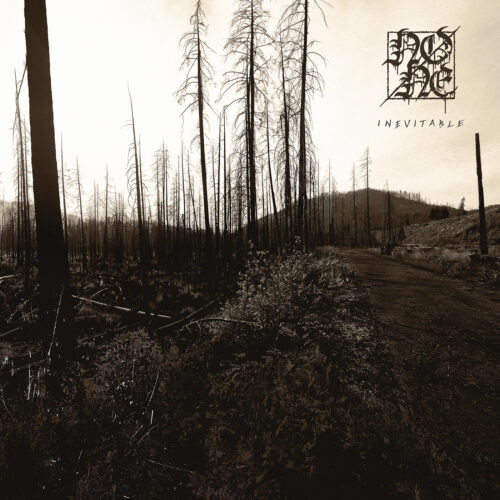
With From the Voids, Norway’s Malum delve even deeper into the abyss. More aggressive, more direct, and emotionally unrelenting, the new album stands as a decisive step in the band’s evolution, moving away from pure introspection toward a frontal confrontation with the world, its decay, and the existential void that runs through it. Rooted in the bleak tradition of second-wave black metal, yet shaped by a contemporary vision marked by existentialism and nihilism, Malum transform anger, despair, and disillusionment into raw, cutting sonic matter.
In this interview, we spoke with A.A., the mind behind Malum, about the genesis of From the Voids, the importance of confrontation as a creative driving force, the relationship between tradition and modernity in Norwegian black metal, and the role of the “void” as an inevitable space of reflection and acceptance. A lucid and uncompromising conversation, true to the music Malum delivers.
M.I. – From the Voids is described as Malum’s next chapter: more aggressive, angrier, and more confrontational than Towards Nothingness. What inner or external forces pushed the band toward this harsher and more ruthless expression?
This direction did not emerge out of nowhere. The aggression introduced on Towards Nothingness is simply carried further on From the Voids. It is a natural continuation, both musically and lyrically. Where Ad Mortem and In Nauseam revolved around the self and inner struggle, Towards Nothingness and From the Voids turn outward, toward the world, its decay, and our own frustration with it. At the same time, we acknowledge that we are not observers without guilt. We are part of the collapse we describe. That is the hard truth emerging from the voids. Conceptually, this marks a movement away from a purely nihilistic, self-loathing perspective toward something more existential and resigned.
M.I. – While the album builds on Malum’s established sonic foundation, it clearly sharpens and intensifies that vision. At what point did you realise this record needed to be more direct and violent in its delivery?
That decision was made immediately after the release of In Nauseam, before the writing process for From the Voids had even begun. At that point, it was clear that the next record
had to be more direct and uncompromising in its expression. The early demo phase started together with former member E.F. and was later continued with M.F., but the intent remained the same throughout: to create a record with a level of sharpness and intensity that felt necessary for Malum at that time. Our working method also plays a role. We work exclusively with pre-production demos, rather than rehearsed material. As a result, the character of each song reveals itself gradually during the recording process.
M.I. – Anger seems to be a driving force behind From the Voids, not as chaos, but as focus. What role does anger play in Malum’s creative process… is it a catalyst, a weapon, or a mirror?
You will certainly find anger as one of the forces, alongside sorrow, despair, and loathing - all of which play central roles in Malum, both musically and lyrically. These emotions function as catalysts, shaping how we move sonically and how the atmosphere is constructed. That said, existentialism is the primary driving force behind From the Voids . Anger is a tool, but not the core.
M.I. – The album is described as a “ruthless observation of the world as it appears: dark, broken, and hollow.” Is this observation rooted more in personal experience, societal decay, or a broader existential perspective?
It is rooted in an existential perspective, filtered through personal experience and individual perception. Even though societal decay is undeniably present, the focus lies on the darker and more uncomfortable aspects of life — emotions that are typically suppressed or avoided, but which Malum allows room to confront directly.
M.I. – Whereas In Nauseam felt deeply introspective, From the Voids appears to project that collapse outward. Was this shift from inward reflection to external confrontation a conscious conceptual decision?
It was a conscious conceptual decision, but one that emerged through personal development rather than a predefined plan. The shift happened gradually, as the focus moved from inward reflection toward external confrontation. The lyrics are a distilled reflection of how I perceive life and the world around me. They function as commentary rather than confession, and as a means of articulating thoughts that are otherwise left unexamined. Concept, lyrics, and music evolved step by step, rather than through a sudden rupture.
M.I. – The record consists of six concise, but uncompromising trcks. Did limiting the album to six songs help distil its message and intensity, or was this simply where the material reached its natural conclusion?
The lyrics are written first, with a deliberately poetic approach, and only six texts were produced for this cycle. The writing process itself is fairly clinical: eight strong compositions or demos are completed, two are set aside and released separately as an EP, and the remaining six form the album. There are practical considerations as well, such as total runtime, but more importantly, the record is conceived as a complete work rather than a collection of isolated songs. Extending it further would have diluted its focus and intensity. Six tracks is where the material reached its natural and necessary conclusion.
M.I. – Malum’s sound is rooted in the bleak traditions of second-wave black metal, yet shaped by modern existentialism and nihilism. How do you balance reverence for tradition with the need to express something contemporary and personal?
We value the primitivism black metal offers, but approach it with a degree of restraint and intent. As deeply invested listeners and active participants in the genre, combining respect for tradition with a contemporary perspective feels neither forced nor contradictory. The modern existentialism is primarily found in the lyrics, but the music itself can also be described as modern — not through rejection of tradition, but by extending and refining a framework that was already established.
 M.I. – You mention a “cold and faceless descent toward inner collapse”. How important is emotional detachment in Malum’s music, and where does catharsis emerge within that coldness?
 It reflects an awareness of wasted potential and the irrelevance of superficial distractions. Life is short, yet much of it is spent on self-deception, religion, false absolutes, and fear. Emotional detachment functions as a necessary distance rather than an absence of feeling. The music itself is not detached, but driven by anger, frustration, and resentment toward existence. These emotions are confronted without filters or resolution. Catharsis arises from the confrontation itself — what the listener chooses to do with it is entirely their own responsibility.
M.I. – Tracks like In Gloom II and Hollow suggest continuity, repetition, and deepening states of despair. Do you see Malum’s discography as an ongoing philosophical arc rather than separate statements?
Malum’s discography can be seen as an ongoing philosophical and musical journey. Each release, however, emphasizes different aspects of that journey. Ad Mortem and In Nauseam focused on the individual self, while Towards Nothingness and From the Voids confront the collective: the world and our place within it. In that sense, continuity is maintained not through repetition, but through an evolving exploration of perspective and despair.
M.I. – The Norwegian underground has a long and imposing black metal legacy. As a band that rose “from the ashes as a brand-new entity,” how do you position Malum within that lineage without being consumed by it?
Malum began as a simple studio project. The goal was to create atmospheric black metal that continues a sound we feel is underrepresented, while maintaining our own perspective. We are aware of the Norwegian black metal lineage, and see ourselves as both a consequence and an extension of that tradition. We do not seek to emulate it — rather, we approach it as a framework from which to carve our own path. Positioning ourselves within that lineage is about respecting the tradition without being consumed by it.
M.I. – Malum is described not merely as a band, but as a confrontation with the self, with silence, with nothingness. What do you hope listeners are forced to confront when engaging fully with From the Voids?
We confront life and the world as we perceive it, without filters or compromise. The intention is to force the listener to face what is often ignored or avoided… to encounter the void, the silence, and the darker aspects of existence. What they do with that confrontation is not for
us to decide.
M.I. – Oppression and catharsis coexist strongly in your music. Do you believe true catharsis can only come after total confrontation with despair, or is there still space for transcendence within Malum’s vision?
True catharsis cannot exist without confrontation. In facing despair and frustration directly, there emerges a form of internal resolution, not transcendence, not comfort, but a clarity or inner stillness. Whether anything lies beyond that is not something we aim to define.
M.I. – With influences compared to Mgła, Groza, In Twilight’s Embrace and the Polish and Nidrosian scenes, how important is atmosphere versus message in Malum’s songwriting?
Atmosphere and message are equally important. The music must reflect the lyrics so that the emotions are physically felt. Lyrics are fundamental to Malum; the conceptual content carries the same weight as the music itself, presenting very real emotional states without resolution. While the Polish and Nidrosian scenes differ, both emphasize atmosphere. Malum occupies a space between them: we follow a path shaped by the Polish sound, which we consider necessary, but From the Voids introduces elements that are more pronounced than before.
M.I. – The album’s title, From the Voids, suggests emergence rather than disappearance. Is this “void” something to be escaped, embraced, or eternally inhabited?
The “void” represents a particular darkness we aim to articulate — a way of perceiving life and existence. It is not to be escaped, but embraced, fully acknowledged as part of the reality we inhabit.
M.I. – Finally, after releasing From the Voids, where does Malum go next… deeper into nothingness, or toward a different form of confrontation altogether?
The immediate focus is on bringing From the Voids to the stage and to a wider audience. Confrontation remains necessary, both toward the world and ourselves. Too many sit comfortably in righteousness and false certainty. We will continue along the path we have chosen. Where it leads is for the listener to witness.
For Portuguese version, click here
Listen to Malum, on Spotify
Questions by Sónia Fonseca